

Hybrid Solar Dryer
We created a hybrid solar dryer for our businesses which can be used to dry the fruit before shredding and turning into flour.
Why Should We Dehydrate Fruit?
Fresh fruit is delicious (we love breadfruit, mangos, bananas you name it) but they don’t last forever. Leave a fruit on your kitchen counter for a few days and surely it will spoil. Furthermore fruit comes in seasons. Sometimes too much to eat, other times almost none! So how can we preserve the excess for later?
Drying, or dehydrating fruit, removes most of the moisture without cooking. The fruit still has all its nutrients, but now has a long shelf life. Ideally, we take the fruit from 70 – 75 percent moisture content down to 10 – 12 percent moisture, in less than 24 hours for best quality.
Solar Drying
But drying can be expensive. Fuel is expensive and the cost of electricity in many countries is prohibitive. And yet sunshine is in abundance where tropical fruit grow. Solar drying makes so much sense, both economic and environmentally.

Solar drying by the way is NOT photovoltaic. We don’t try to convert the sun’s heat into electricity, store it and then convert it back to heat! That would be very inefficient! We trap the sun’s heat and funnel it over the fruit directly in a safe, hygenic, inexpensive way.
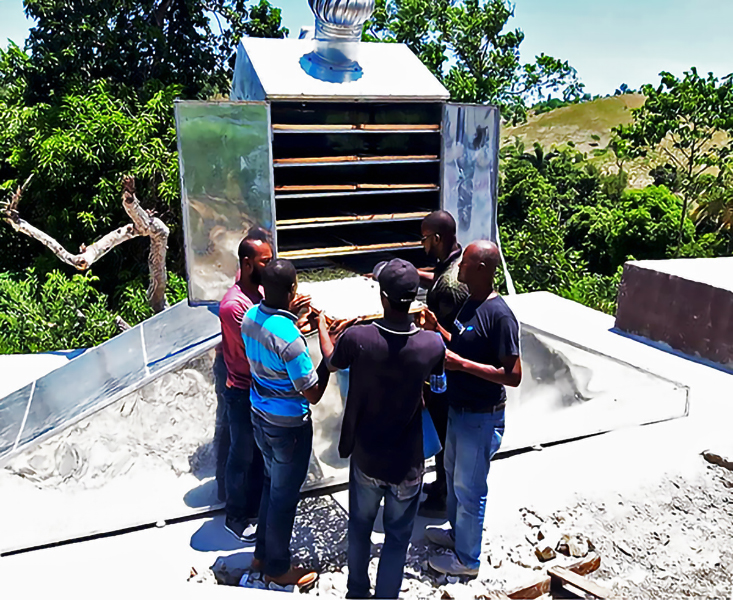
You could just spread fruit out in the sun to dry. But better, more hygenic, TTFF has designed and tested a hybrid solar dryer, and it works well! Here’s a picture of an early prototype …
Hybrid Solar Dryer Design
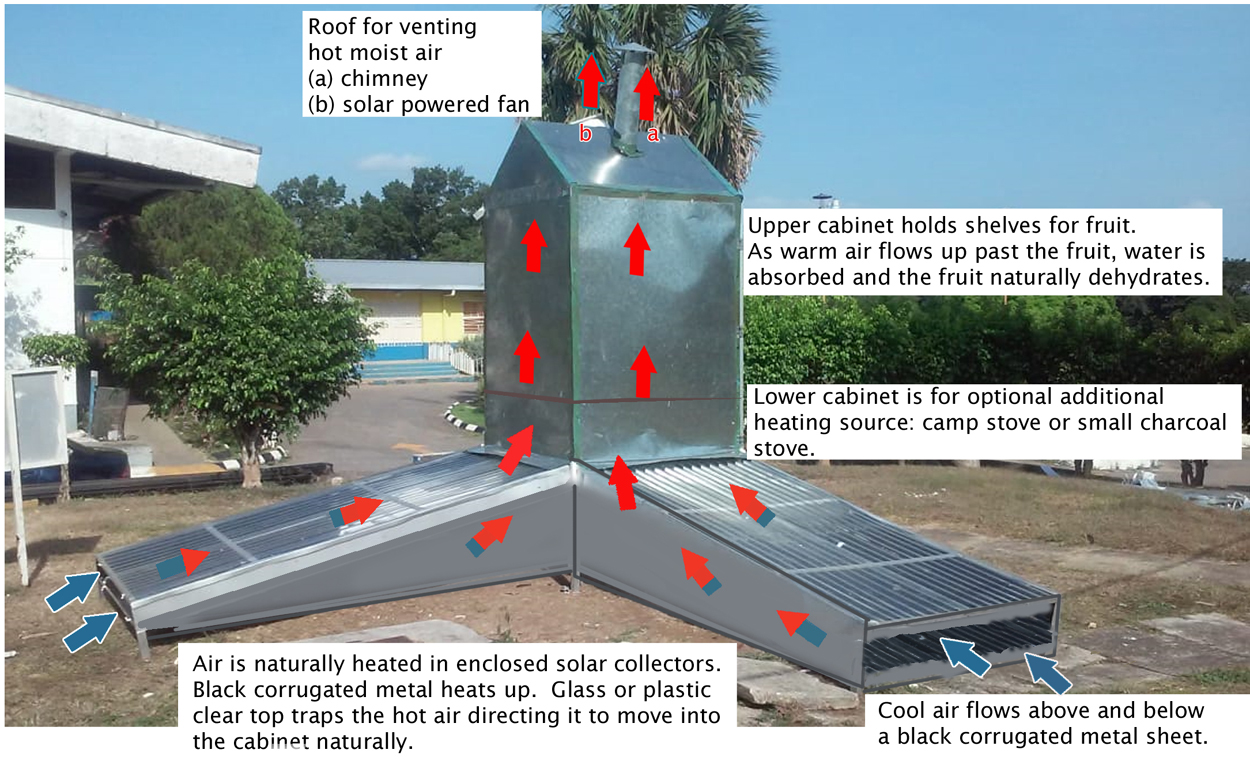
This dryer uses solar collectors feeding hot air into a cabinet. A propane or kerosene heater can be optionally placed in the lower half of the cabinet to supplement solar power when needed, like a cloudy day, hence the Hybrid designation. The upper half of the cabinet holds 4 or 5 mesh wire shelves which in turn hold breadfruit shreds or mango slices placed on trays to be dried. A rooftop shelters the interior from rain and dust, and also holds an exhaust fan and a vent or chimney. It’s essential to remove the moist hot air from the interior of the cabinet.
Watch how this all works with our helpful animation, thanks to Jose Urena. If you want to learn about the design in more detail, feel free to read the hybrid solar dryer technical paper.
Hybrid Solar Dryers In the Field
We’ve worked with local organizations to build more of these solar dryers in Jamaica and Haiti. Already we have over 20 in use in Haiti and Jamaica, with several more planned. Our users are ecstatic! One person could hardly believe the effectiveness–seemed like it was heated with fuel or electricity–but no. Only the sun. Approximately 100 pounds of fresh fruit can be dried within 4 to 8 hours!
Build Your Own!
TTFF is happy to share design features with anyone that wants to build a hybrid solar dryer! Contact us directly from our website, or email info@treesthatfeed.org. To build your own hybrid solar dryer, view our resources below.
Update: in response to users’ feedback we recommend a few modifications to the original design:
- Paint all exterior metal surfaces black, to increase solar insolation
- Don’t paint the collectors’ clear plastic cover. Use rigid plastic not thin, flexible plastic.
- Build the shelves from galvanized open mesh wire–and place the food to be dried on removable perforated metal trays (picture below)
- We now recommend 5 or 6 shelves not 4.
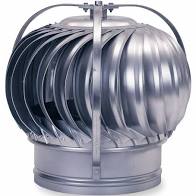
- If possible use a turbine vent instead of a chimney, in addition to the solar fan, to boost air flow (picture below)
- Some people suggest using thermal ballast in the lower cabinet. It doesn’t make much difference but you’re welcome to try it. But don’t use water!
Resources for Building Your Own Hybrid Solar Dryer
First, our assembly guide.
Second, our build instructions.
Third, our complete parts list.
Fourth, cost is very variable depending on sources but the materials costs will run roughly $1,000. The recommended material is galvanized sheet metal on a metal frame for food safety and durability. Exterior parts of the collector modules may be constructed out of weatherproof plywood to reduce cost.
Labor costs vary but figure 80 hours of skilled work such as metalwork, welding, and carpentry. Many groups use volunteer labor to keep costs low.
Fifth, as to energy savings: in developing countries electricity typically costs $0.40 per kilowatt-hour. The equivalent of 6 hours of solar drying (6 kW), 5 days a week, 26 weeks a year, would cost roughly $1,500 to $2,000. This solar dryer will pay for itself in less than a year! So, not a bad return on investment!


(click image)
Trees That Feed can usually help to source these items. Contact us for assistance.
Key Design Features
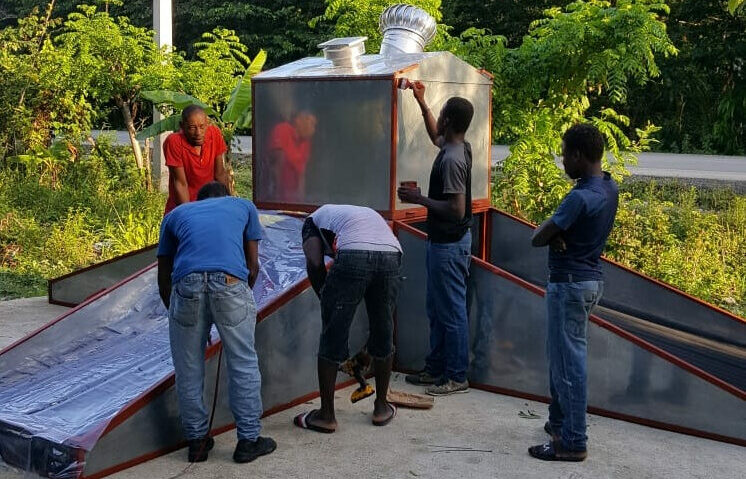
This design is based on experience in Asia where fruit are regularly preserved by drying, along with a project through our partnership with Northwestern University. TTFF developed a first prototype for testing at our Chicago area headquarters.
The key to this solar dryer is the solar collector module. This is made from a 4′ x 8′ corrugated metal sheet, painted black, within an enclosed frame, covered by a clear plastic top. Direct sunlight heats the metal sheet. Outside air passes above and below the corrugated metal and warms up, typically 30 – 35 degrees Fahrenheit above ambient temperature. This warm air has low relative humidity and readily absorbs moisture. The plastic cover provides a greenhouse effect to capture the heat and to feed warm air up into the cabinet. Solar energy at the earth’s surface is approximately 1 kW per sq. meter. This collector is roughly two square meters. As such, with three collectors, up to 6 kW of heat energy enters the drying cabinet.
Solar Dryer Components
The solar dryer comprises six modules: three collectors, lower cabinet, upper cabinet and roof. Collectors funnel warmed air into the cabinet. Optionally, the lower cabinet can house a fueled heater, such as a kerosene stove, in case of a cloudy or rainy day. The upper cabinet holds 4 or 5 shelves which carry the fruit. So, as warm, dry air rises through the cabinet, it absorbs moisture and dehydrates the fruit.

The last module is the roof, which both protects against rain and augments natural convection. The roof contains a solar exhaust fan and a turbine vent or chimney. Cabinets must not be sealed off! We’ve seen that mistake made. Moist air has to be pulled out! By transporting moisture away, the fruit becomes drier. This solar dryer works for breadfruit, mango, paw paw and many other fruit, depending on what is in season.
Your humble designer Mike McLaughlin was a Physics major from way back. His calculations have optimized the dimensions, cost and performance of this design. So, change this design at your own risk!
Click Boosting Agribusinesses to go back to the program’s landing page.